Moosky AI field guide
AI UGC Ads for SaaS and E-commerce Founders: The Ad-Creative Workflow (With Real Credit Costs)
The founder-run AI UGC ad workflow: pick Seedance 2.5, Wan 3.0, or LTX 2.5 per shot, batch hooks on the cheap engine, and the real credit cost of a whole ad set.
On this page
AI UGC Ads for SaaS and E-commerce Founders: The Ad-Creative Workflow (With Real Credit Costs)
Paid social does not care how good your product is. It cares whether the first three seconds stop a thumb, and it burns through whoever stops it: a hook that pulled a 2% CTR in July is invisible by October. For a SaaS or e-commerce founder running their own campaigns, the bottleneck is almost never the offer. It is creative volume. You need a dozen openings, a few demos, and a way to refresh a decaying winner this week, not next quarter after an agency scopes it.
This is the workflow for producing UGC-style ad creative end to end with Moosky: which video model to reach for on each shot, what every run actually costs in credits, and how to batch variants so a losing hook is a line item instead of a lost afternoon. Credits are the platform's currency at a fixed 100 credits = $1, bought in packages, no subscription. Every number below is computed from the composers' own pricing code in the Moosky repo, and failed runs are refunded automatically.
Why the founder, not the studio, should own the creative loop
An agency delivers a finished spot and then charges for every revision. That model assumes creative is scarce and iteration is expensive, so you ration tests. The economics of AI generation invert it: a variant is one quoted run, the price shows before you click, and an unused balance carries across quarters. When variants cost minutes and a known number of credits, you test in the volume that actually lowers CPA. The founder who can re-brief a stale ad the same afternoon the numbers dip beats the one waiting on a procurement cycle, regardless of who has the better editor.
The catch is that "AI video" is not one tool. A talking-head hook, a product-in-hand demo, and a cinematic b-roll cut want different engines, and the wrong pick is either an expensive clip that underperforms or a cheap clip that looks off. The rest of this guide is about making that choice deliberately, with the price of each branch on the table.
Pick the engine per shot, not per campaign
Moosky runs three frontier video models behind the same credit balance. Read them as three specialists you assign shot by shot.
Seedance 2.5 is the premium cinematic engine: text-to-video or optional first/last-frame clips, 4 to 30 seconds, 480p to 1080p, with native synchronized audio in the same pass. It is the one you spend on the hero render or a 16-to-30-second single take where instruction-following and shot quality carry the ad. The composer tags it very-high cost and says so plainly: prefer a cheaper model for routine short clips.
Wan 3.0 is the motion specialist. It is built for camera moves that feel operated, physics that land, and long one-takes, running text-to-video, first-frame image-to-video, and first/last-frame interpolation up to 30 seconds at 1080p with native audio. Its own pricing is medium-high. Use it when the shot depends on movement, and keep exact lip-sync and on-screen text off its critical path (see the Wan 3.0 workflow guide).
LTX 2.5 is the mid-cost talking-head engine. It does text-to-video and start-frame clips with native joint audio (dialogue, ambience, SFX) and is the composer's stated strength for talking-head and dialogue scenes with simple controlled motion, multi-shot continuity, and first/last-frame control at 720P to 4K. This is your workhorse for the volume: hooks and reads at a price you can batch.
A rule of thumb that survives contact with the invoice: draft and batch on LTX 2.5, cut the hero or the complex motion shot on Seedance 2.5 or Wan 3.0, and never open an expensive model on an untested hook.
The honest credit cost of the whole ad
Every run is a 10-credit base plus a duration-and-resolution charge, quoted live in the composer before anything renders, and refunded on failure. Here are the three grids, computed from each composer's pricing code (credits, at 100 = $1).
LTX 2.5, the talking-head workhorse:
| Clip length | 720P | 1080P |
|---|---|---|
| 5s | 80 | 110 |
| 10s | 149 | 210 |
| 15s | 218 | 310 |
| 20s (max) | 287 | 410 |
Seedance 2.5, the premium cinematic engine:
| Clip length | 480P | 720P | 1080P |
|---|---|---|---|
| 5s | 125 | 267 | 641 |
| 10s | 238 | 521 | 1267 |
| 15s | 351 | 775 | 1892 |
| 20s | 464 | 1030 | 2518 |
| 30s (max) | 690 | 1538 | 3769 |
Wan 3.0, the motion specialist:
| Clip length | 480P | 720P | 1080P |
|---|---|---|---|
| 5s | 49 | 87 | 164 |
| 10s | 87 | 164 | 318 |
| 15s | 126 | 241 | 472 |
| 30s (max) | 241 | 472 | 934 |
Three things to internalize before you budget a campaign.
- Resolution is the multiplier, not a rounding error. On every model, the jump from 480P to 720P roughly doubles the per-second rate and 1080P doubles it again. Draft low; only the keeper gets the top tier.
- Seedance 2.5 is a production decision, not a scratchpad run. A 10-second 1080P take is 1267 credits, about $12.70 in credits. That is fine for the one hero shot per campaign and wasteful for the ninth hook variant.
- A whole test set is cheap when you batch on the right engine. Five 5-second 720P hooks on LTX 2.5 is 400 credits, about $4. Then one 10-second 1080P hero on Seedance 2.5 adds 1267. A founder's first real ad set lands well under $25 in credits, which is the point: volume is affordable, so you can afford to be wrong five times to be right once.
The workflow, step by step
1. Write the brief once, as a campaign note
Before any prompt, write a single reusable note: the product, the price or offer, the promise, the audience, and where the ad will fly (feed, reel, in-stream). Attach your pack shots or app screenshots so every render references the same real thing. This is the object you reuse across every variant, so the message stays identical while only the opening changes. Locking the brand frame once is what lets a batch stay on-brand by default instead of by luck.
2. Draft the hook, not the whole ad
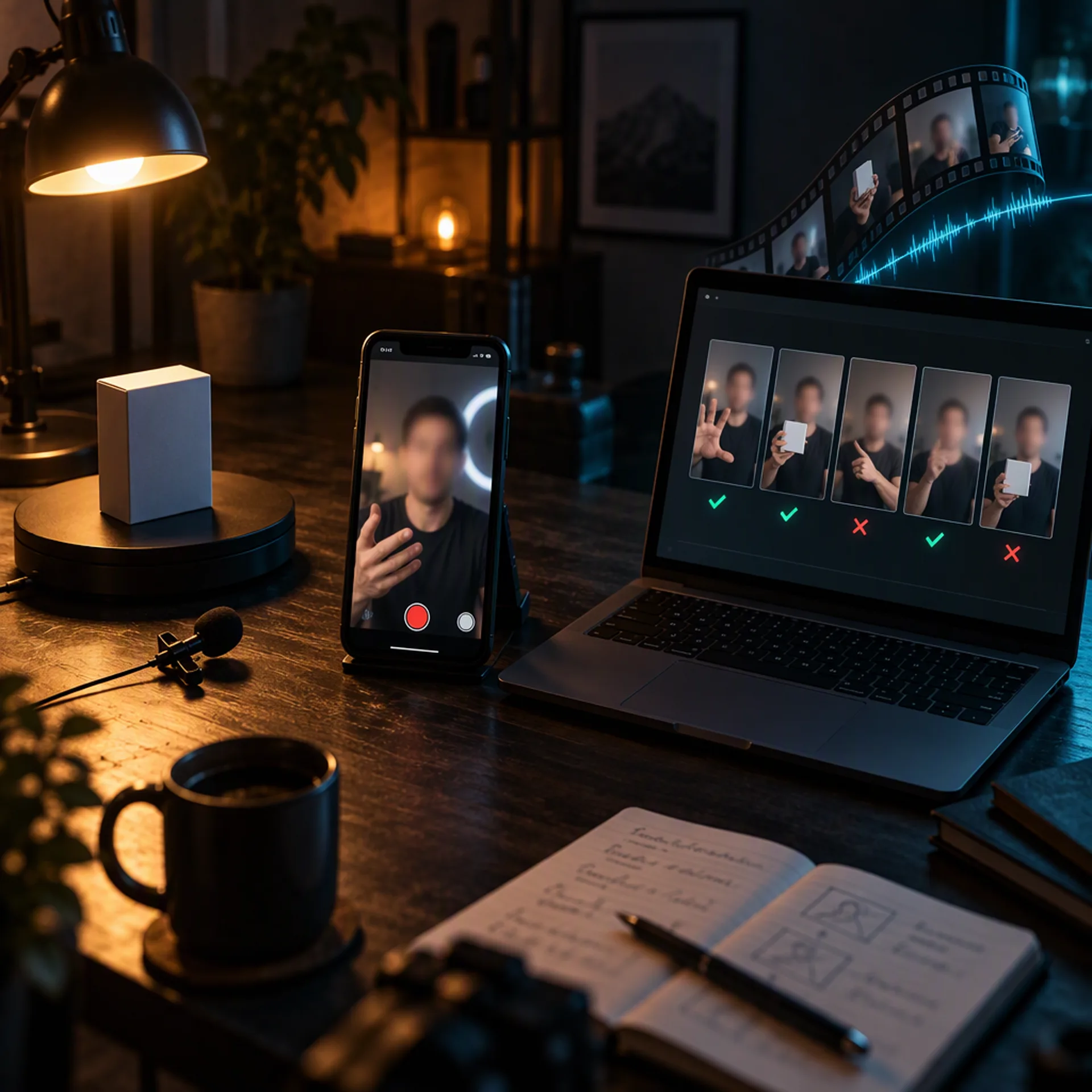
A UGC-style ad lives or dies in the first three seconds. A working read is 20 to 35 seconds inside a simple shape: hook (0-3s), problem and turn (3-12s), demo (12-25s), plain call to action. The script shape and the creator-identity lock are covered in depth in our AI talking-head UGC ads guide; what matters here is that you write three to five alternative hooks against one body. Different hooks on a stable body is where most of the campaign lift comes from, and it is the exact thing that is cheap to generate and expensive to shoot.
3. Batch the openings on the mid-cost engine
Open the LTX 2.5 composer and run the same brief and body against each hook angle: a question, a bold claim, a cold demo, an objection handled, a story open. Because each run is quoted in credits first, you are comparing openings like a media buyer, not a gambler. Keep the talking-head register deliberate in the prompt: casual framing, natural light, a slight handheld wobble, an ordinary room. Ask for polish and you get a studio spot, and a studio spot is what makes a UGC ad skippable. For the deeper multi-scene identity inheritance, the same reference face across the batch is what makes five clips read as one creator.
4. Spend the hero render on the winner only
Once one hook survives a scroll test, give it the good engine. A cinematic motion shot or a long single take goes on the Seedance 2.5 composer or, when the shot is all camera movement and physics, on Wan 3.0. Native audio means the announcer read, ambient sound, and lip-synced dialogue land in the same pass, so the file that downloads is close to upload-ready rather than a rough cut you still have to finish. For a full multi-scene ad where a planner should inherit references across scenes and let you reshoot weak takes, hand the brief to Project Director; the UGC ads workflow is built around that selfie-hook-to-demo-to-CTA structure with a locked creator.
5. Ship variants and read the first three seconds
Upload the keepers as separate creatives and let the platform decide. The metric that predicts winners early is the three-second view rate (hook hold); after spend, CPA decides. When a hook holds but does not convert, the body script is wrong, not the face, so regenerate the body against the winning hook and keep everything else fixed. If you are running the pure variant-batch play, the AI video ad generator page lays out the brief-once, batch-the-hooks, kill-losers-cheaply loop for SaaS and e-commerce media buyers.
What still goes wrong
Lip-sync is good but breaks on extremes: very fast speech, overlapping dialogue, and hard profile angles. Keep delivery conversational and front-facing. Uncanny hands holding a product are a tell, so keep product-in-hand shots short or anchor them to a real pack shot. On-screen text and readable logos are approximate on the motion models, so never build a shot around a headline the engine has to render; burn captions in post instead. And disclosure rules for synthetic people are tightening on some networks, so check each platform's policy on AI figures in ads and label where required. The failure mode is not that the model cannot make a video. It is shipping a polished-looking clip that reads as an ad and gets skipped, which is exactly what the handheld register and the hook discipline above are there to prevent.
Start with one product, five hooks, and a $25 budget
The loop in one line: write the brief once, batch three-to-five hooks on LTX 2.5 where a wrong guess costs under a dollar, spend one Seedance 2.5 or Wan 3.0 hero render on the survivor, export with native audio, and let the three-second data tell you which reshoot to run. A founder can refresh a decaying winner the same afternoon for a known credit price, which is the whole reason the workflow is worth owning instead of outsourcing.
Try it on Moosky AI: reference-locked talking heads, three video engines on one credit balance, and per-run credit quotes before anything renders.
Create with Moosky AI
Turn ideas into finished productions
Access leading AI models and production workflows from one workspace.
Try Moosky AIComments
Comments are reviewed before they appear publicly.
Join the discussion — sign in or create an account to leave a comment.
No approved comments yet. Start the conversation.